DVB-T2 FECFRAME – What is it?
FECFRAME is a fundamental DVB-T2 system parameter. There are two FECFRAME values: long (64 800 bits) and short (16 200 bits).
FEC (Forward Error Correction) is a technique that is used for correcting errors in data transmission over noisy communication channels. The transmitter accomplishes FEC by adding redundant check bits to the input data stream using a certain algorithm. Because of the redundancy the receiver is enabled to detect a limited number of errors that may occur in the received data stream.
The FEC method used in DVB-T2 is a concatenated LDPC (Low-Density Parity-Check) and BCH (Bose-Chaudhuri-Hocquenghem) code.
The input to a DVB-T2 system consists of one or more logical data streams. Each data stream is sliced into data fields which are called baseband frames (BBFRAMEs). A FECFRAME consists of a BBFRAME and its redundant check bits – the check bits of the BCH outer code, and the check bits of the LDPC inner code.

Composition of DVB-T2 FECFRAME
The number of bits in the FECFRAME is always constant – 64 800 bits (long) or 16 200 (short). The number of bits in the BBFRAME, BCH, and LDPC field is dependent on the selected code rate. For example, using the long FECFRAME and code rate 3/4, the number of bits in each field is: 48 408 (BBFRAME), 192 (BCH), and 16 200 (LDPC).
In the table below follows a short summary of the pros and cons for long and short FECFRAME.
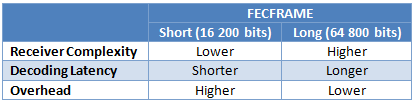
A short summary of the pros and cons for short and long FECFRAME
For more information about the DVB-T2 FECFRAME system parameter, see the following reference: ETSI EN 302 755 V1.3.1 (2012-04). Digital Video Broadcasting (DVB); Frame structure channel coding and modulation for a second generation digital terrestrial television broadcasting system (DVB-T2).
–
Thank you for reading this article regarding DVB-T2 FECFRAME. If you have any questions about this article do not hesitate to contact me. All feedback is welcome!
 Pär Nygren